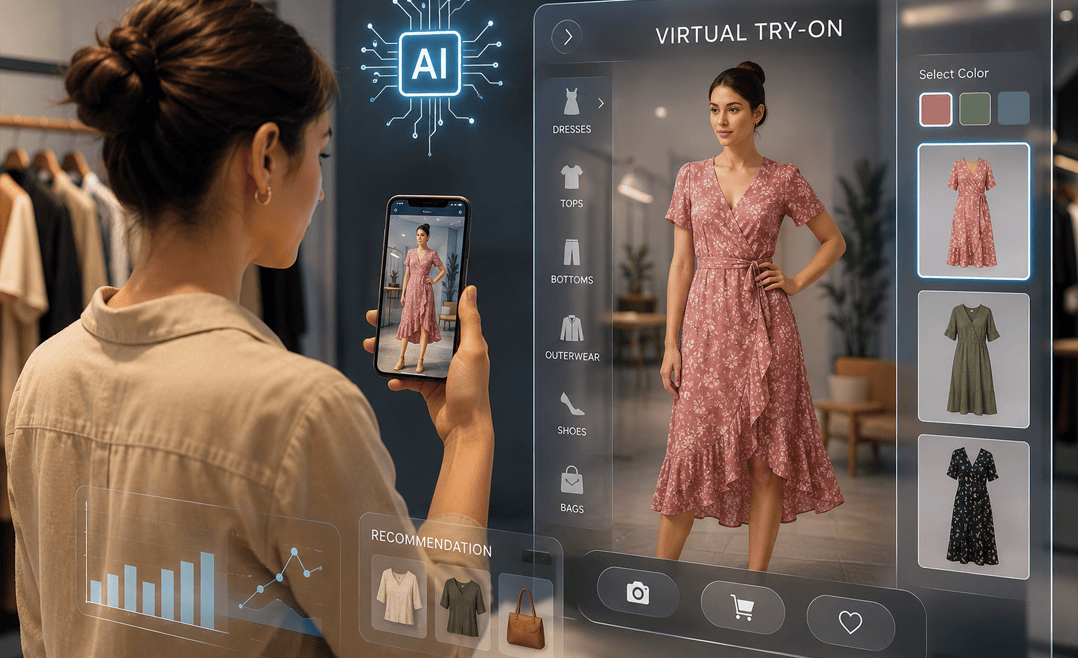
AI Meets Fashion: The Rise of Virtual Try-On Technology
Online Shopping Is Becoming More Experiential
Online fashion shopping is no longer limited to browsing product images, reading descriptions and adding items to a cart. Consumers increasingly expect digital experiences that help them visualize, evaluate and personalize products before making a purchase.
Virtual try-on technology is emerging as an important part of this transformation. By combining artificial intelligence, augmented reality and mobile technology, retailers can allow consumers to see how clothing, accessories, eyewear or beauty products may look on them before buying.
The scale of this shift is reflected in the virtual try-on market. The global market was valued at USD 9.2 billion in 2023 and is projected to reach USD 46.4 billion by 2030, representing a 26.4?GR between 2024 and 2030. Apparel and clothing represent the largest application segment, while smartphones and tablets remain the leading devices for virtual try-on experiences. But the bigger story is not simply the growth of technology. It is how virtual try-on is changing consumer expectations around confidence, personalization and digital shopping.
From Product Browsing to Virtual Experience
One of the biggest limitations of online fashion and beauty shopping has always been the inability to physically experience a product before purchasing it. Consumers may like a particular color, style or design but remain uncertain about how it will actually look on them.
This remains a significant online shopping pain point. Studies show that 34% of consumers identified the inability to try products before buying as a major frustration. At the same time, 23% of consumers expressed interest in virtual try-on tools, demonstrating the growing demand for more interactive digital shopping experiences.
Virtual try-on therefore addresses more than convenience. It helps reduce uncertainty by bringing an element of physical shopping experience into the digital environment.
AI Is Making Shopping More Personalized
The evolution of virtual try-on is also closely connected to artificial intelligence. Instead of simply displaying a digital product over an image, AI-powered solutions can analyze facial features, body positioning and individual characteristics to create more realistic and personalized experiences.
Technology is particularly relevant in beauty and fashion, where fit, color and appearance strongly influence purchase decisions. Studies highlight AR beauty try-on as an increasingly important form of lasting innovation, with leading brands investing in technologies such as AI-based shade selection, skin diagnostics and AR try-on.
This shift reflects a broader movement toward personalization. Consumers increasingly expect digital commerce to understand their preferences rather than provide the same experience to everyone.
Virtual Try-On Can Influence Purchase Decisions
The commercial impact of these experiences is becoming increasingly visible. Perfect Corp.’s case study of The Iconic found that shoppers using virtual try-on recorded 55% higher add-to-bag actions, while add-to-Wishlist activity increased by 16% among iPhone users and 21% among Android users. The number of customers using virtual try-on also increased by 180% monthly after the feature was made more prominent within the app.
Similarly, research reported by Retail Dive found that brands experienced a 2.5-times increase in sales conversion after implementing virtual try-on technology. More than 38% of respondents identified virtual fitting rooms and try-ons as the most effective application of AI and AR technologies.
These results suggest that virtual try-on is moving beyond an engagement feature and becoming a potential conversion tool.
AR Is Becoming Part of Everyday Shopping
Consumer behavior is also becoming more receptive to immersive technologies. Clutch’s 2026 survey of 400 consumers found that 60% had used AR or VR, while 58% had used AR before making a purchase. In addition, 30% use AR for online shopping and virtual try-ons, showing that immersive technology is increasingly becoming part of everyday digital behavior. Smartphones remain the primary access point, used by 61% of consumers for immersive experiences.
For retailers, this creates an opportunity to integrate virtual experiences directly into mobile shopping journeys rather than treating them as separate technological experiments.
What This Means for Fashion Brands
Virtual try-on goes beyond creating a more entertaining shopping experience. It connects technology, personalization, customer confidence, product discovery and conversion within a single digital journey.
As online competition increases, brands have to offer more than attractive product images. They must understand what creates confidence, what reduces purchase hesitation and what encourages consumers to explore unfamiliar products.
The future of virtual try-on is therefore not simply about making digital shopping look more futuristic. It is about making online shopping feel more personal, informative and closer to the physical shopping experience.
How HBGTM Insights Can Help
HBGTM Insights helps organizations understand changing consumer behaviors through market research, customer experience measurement, audience segmentation and behavioral research.
As consumers increasingly interact with brands through AI-powered and immersive experiences, understanding what drives adoption, trust, engagement and purchase decisions can help organizations develop more relevant digital commerce strategies.
Virtual try-on is transforming the online shopping journey from simply seeing a product to experiencing it.
The next opportunity for brands is not simply to adopt the technology — but to understand why consumers use it, what makes the experience credible and how it influences the decisions they make.
Visit www.hbginsights.com to explore how research-driven insights and custom intelligence solutions can help organizations understand evolving consumers and build stronger, more relevant strategies.
Discover MoreAbout The Author

Sagar Gulati
Sagar is an accomplished insights professional with 3.5 years of experience leading end-to-end market research projects across global FMCG portfolios. His background includes roles at NielsenIQ, Reliance, and Kantar, where he managed high-visibility strategic studies for Fortune 500 clients such as Nestlé, Unilever, Johnson & Johnson, and Coca-Cola India.
He brings deep expertise in product testing, brand health measurement, concept validation, and shopper behaviour research, coupled with strong cross-regional experience working with stakeholders across APAC and Europe. Known for his analytical rigor and client-centric approach, Sagar consistently delivers actionable insights that drive brand and business impact.
Sagar holds a B.Pharm degree and is a registered pharmacist with the Haryana Pharmacy Council, and he completed his MBA in Marketing from ICFAI Mumbai.
Know More