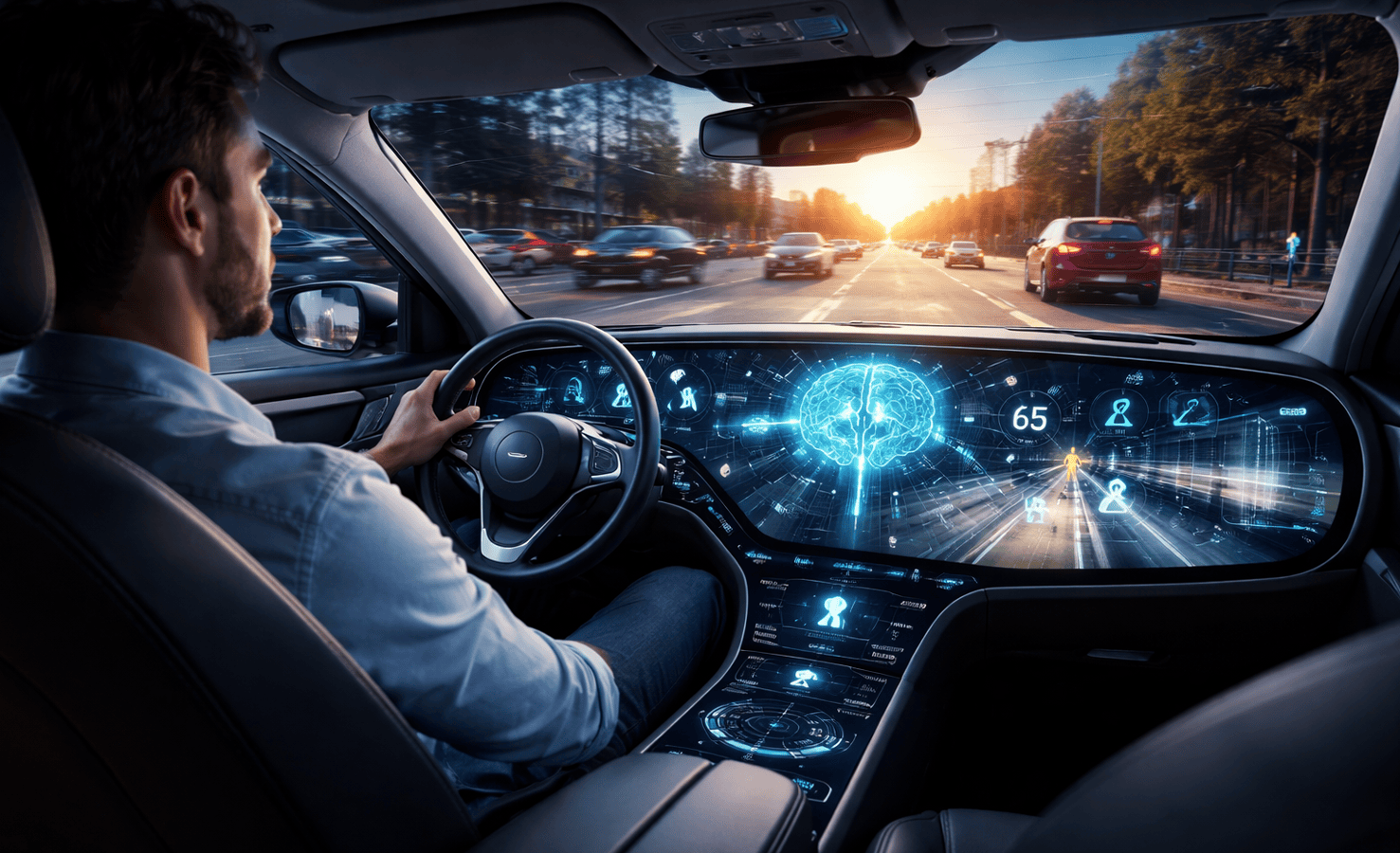
How Artificial Intelligence Is Changing the Way Cars Think, Decide, and Support Drivers
Can Cars Really Make Decisions? And Should We Trust them?
When we talk about AI in cars, the first question most people ask is simple: Can a car actually think? The honest answer is—not like a human, but enough to help us drive better. Today’s vehicles are no longer just machines that follow commands. They observe the road, analyze situations, and assist drivers in moments where human reaction alone may fall short. This gradual shift—from assistance to decision-making—is redefining how we experience driving.
What Does AI in Automotive Automation Really Mean?
At a basic level, AI-driven automation allows cars to process large amounts of information quickly and respond without constant human input. Unlike older systems that worked on fixed rules, AI learns patterns and adapts to changing conditions. For a lay reader, it helps to think of AI as technology that helps a car understand what’s happening and respond appropriately, rather than simply reacting after something goes wrong.
The Starting Point: Helping the Driver, Not Replacing Them
AI initially appeared in automobiles as a support system. Its purpose was to increase safety, raise awareness, and lessen driver stress. These early systems concentrated on keeping an eye on the position of the car, its environment, and the driver's actions, only intervening when required. While AI worked silently in the background to guide, alert, and assist, the driver maintained complete control.
This phase was important. It allowed people to become comfortable with intelligent systems without feeling that control was being taken away.
When Assistance Turns into Decision Support
As AI systems matured, they began handling more complex situations. Instead of only alerting drivers, AI started making limited decisions—such as adjusting speed, maintaining stability, or responding to sudden changes in road conditions. These decisions are not random. They are based on continuous observation, prediction, and prioritization of safety.
At this stage, driving becomes a shared effort. Humans provide intent and oversight, while AI supports judgement when situations become demanding or unpredictable.
How AI “Understands” the Roads
Data Collection
AI first gathers information about its surroundings using sensors and inputs.
Real-Time Interpretation
It then analyzes this data instantly to understand what is happening.
Decision Evaluation
AI evaluates different possible outcomes and chooses the safest or most effective response.
Continuous Learning
Over time, the system learns from new situations, improving its decisions beyond fixed, rule-based automation.
Beyond Safety: A More Personal Driving Experience
AI is not only about safety. It also makes driving more comfortable and intuitive. Vehicles can adapt to driver preferences, simplify controls, and reduce distractions through natural interaction. Over time, the car begins to feel less like a machine and more like a responsive companion that adjusts to individual needs.
At a broader level, AI supports traffic efficiency, energy management, and predictive maintenance, which is quite important to improve how vehicles fit into daily life.
Why Trust and Transparency Matter
Despite its benefits, AI in cars raises important concerns. Data privacy, system reliability, and public trust remain central challenges. Drivers want to understand how decisions are made and feel confident that systems will behave responsibly. Building trust requires not just advanced technology, but clear communication and thoughtful design.
From Helping Hands to Responsible Decisions
AI in cars is not about removing humans from the equation. It’s about helping people drive safely, comfortably, and confidently. As vehicles move from basic assistance towards informed decision-making, the real progress lies in balance—where technology supports human judgement rather than replacing it.
How HBGTM Insights Can Help
As automotive intelligence grows, understanding human expectations becomes just as important as technological capability. HBGTM Insights specializes in consumer trust and behavior research, customer experience and loyalty measurement, and personalization effectiveness and privacy perception analysis.
Using an intelligence-driven approach, HBGTM Insights helps consumer-focused organizations design scalable, compliant, and meaningful experience strategies grounded in real consumer understanding. Effective commercialization starts with stronger insights. Whether refining engagement strategies, aligning experiences with privacy expectations, or strengthening long-term trust, HBGTM Insights supports confident, insight-led decision-making.
Consult with HBGTM Insights
Visit www.hbginsights.com to explore how research-driven intelligence can unlock value, strengthen trust, and support long-term growth.
Discover MoreAbout The Author

Ankur Malhotra
Ankur is a research and knowledge leader with 20+ years of experience in business and financial research, serving clients across investment banking, consulting, accounting, and advisory. He has expertise in establishing global knowledge centers, delivering business intelligence solutions, and driving thought leadership. Before joining HBGTM Insights, Ankur worked with Forvis Mazars, Korn Ferry, and was part of the founding team of Acuity Knowledge Partners. He is a CFA charterholder from ICFAI, Hyderabad, and a graduate of Delhi University.
Know More