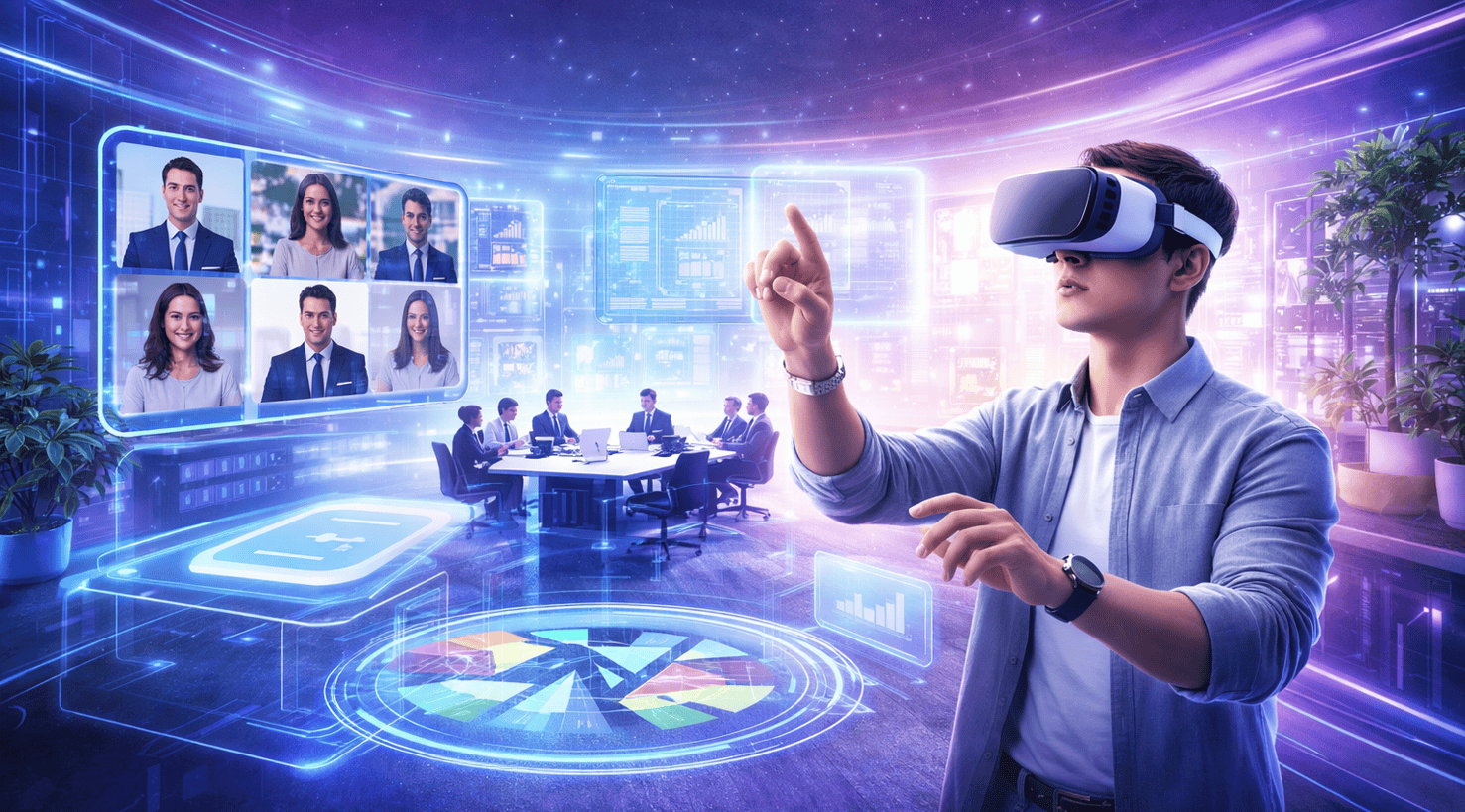
The Rise of Virtual Offices and Immersive Workspaces Shaping the Next Generation of Work
Why Is the Workplace Changing — and What’s Driving It?
What does “workplace” really mean today?
Is it still a physical office with desks and meeting rooms, or is it something more fluid and digital?
The answer lies in how work itself has evolved. Modern workplaces now depend on collaboration across locations, continuous learning, and faster decision-making. Virtual offices and immersive technologies like augmented reality (AR) and virtual reality (VR) are stepping in to support this shift by creating digital environments where people can work, interact, and learn more effectively—without being limited by physical space.
What Are Virtual Offices, in Simple Terms?
A shared digital workspace that mimics the layout and operations of a real office is called a virtual office. Regardless of their location, it enables workers to connect, collaborate, and access work resources in real time.
Virtual offices emphasize presence and interaction, in contrast to simple online communication tools. Even when working remotely, they support teams feeling unified, coordinated, and connected. This feeling of "being there" is essential to sustaining engagement, productivity, and teamwork.
Where Do AR and VR Fit into the Workplace?
Immersive technologies strengthen virtual offices by making digital workspaces more interactive and intuitive. AR enhances real-world environments with digital information, while VR creates fully immersive digital spaces for interaction and learning.
In the workplace, these technologies help people move beyond passive screen-based work. Employees can engage with information visually, practice tasks safely, and interact with digital environments in ways that feel natural and hands-on. This supports deeper understanding and better retention of knowledge
Redefining Collaboration and Team Interaction
One of the most important roles of immersive technologies is transforming collaboration. Virtual offices powered by AR and VR allow teams to communicate more clearly, share ideas visually, and work together in real time.
These environments reduce the distance between team members and create a stronger sense of shared purpose. Collaboration becomes more dynamic, focused, and inclusive, helping teams stay connected even when they are physically apart.
A New Approach to Learning and Skill Development
Traditional workplace training often struggles to bridge the gap between theory and real-world application. Immersive technologies address this by enabling experiential learning—where employees learn by doing.
Virtual environments allow individuals to practice tasks, make decisions, and improve skills in realistic yet controlled settings. This approach supports faster learning, builds confidence, and prepares employees for complex workplace situations without real-world risk.
Supporting Better Decisions and Leadership Thinking
Virtual offices and immersive tools also improve how organizations plan and make decisions. Interactive environments make it easier to understand complex information, explore different outcomes, and align teams around shared goals.
For leaders, this means clearer insights, stronger strategic thinking, and more confident decision-making. Immersive environments encourage reflection, foresight, and collaboration—key elements of effective leadership in modern workplaces.
Building More Responsible and Sustainable Work Models
As organizations rethink how work is structured, virtual offices help reduce dependence on physical infrastructure and repetitive processes. This aligns with broader sustainability principles focused on efficiency, transparency, and long-term value creation.
Immersive technologies support smarter use of resources while maintaining performance and employee engagement.
How HBGTM Insights Can Help
Understanding how virtual offices and immersive technologies shape employee behavior, engagement, and trust requires more than technology adoption—it requires insight.
HBGTM Insights specializes in:
- Consumer Trust & Behavior Research
- CX & Loyalty Measurement Studies
- Personalization Effectiveness & Privacy Perception Analysis
With an intelligence-driven approach, HBGTM Insights supports retail and consumer-focused organizations in building scalable, compliant, and high-impact experience strategies grounded in real human insights.
Effective workplace transformation begins with stronger understanding. Whether you are evaluating digital engagement models, redesigning experience strategies, or aligning innovation with trust expectations, HBGTM Insights is here to support you.
Visit www.hbginsights.com to explore how research-driven solutions and custom intelligence platforms can unlock value, strengthen trust, and drive long-term growth.
Discover MoreAbout The Author

Ankur Malhotra
Ankur is a research and knowledge leader with 20+ years of experience in business and financial research, serving clients across investment banking, consulting, accounting, and advisory. He has expertise in establishing global knowledge centers, delivering business intelligence solutions, and driving thought leadership. Before joining HBGTM Insights, Ankur worked with Forvis Mazars, Korn Ferry, and was part of the founding team of Acuity Knowledge Partners. He is a CFA charterholder from ICFAI, Hyderabad, and a graduate of Delhi University.
Know More