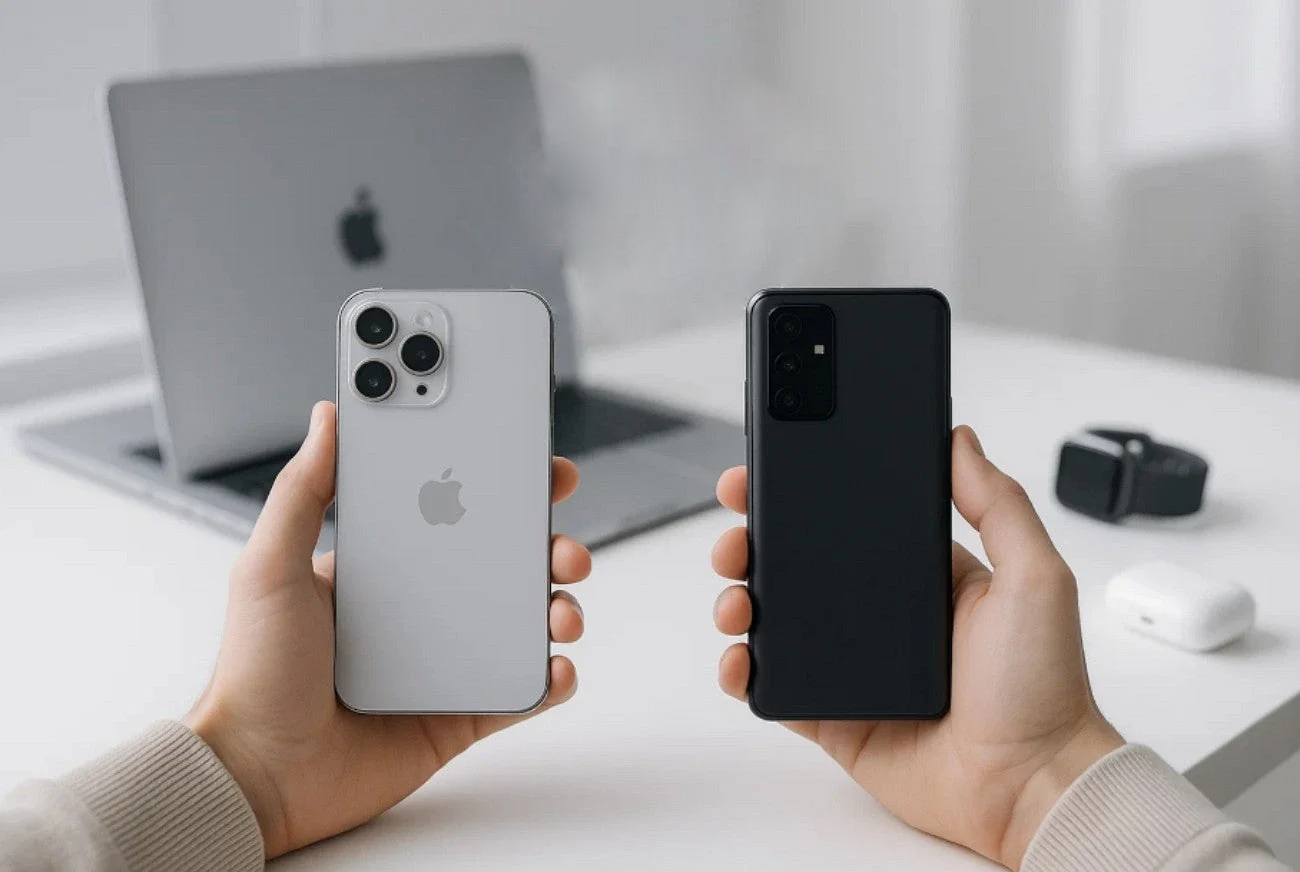
Beyond the iPhone: How Apple’s Ecosystem Is Reshaping Smartphone Competition
The smartphone industry is increasingly shifting from device-led competition toward ecosystem-driven competitive advantage. As market growth moderates and product differentiation becomes more challenging, factors such as ecosystem strength, premium pricing, recurring revenue and customer retention are becoming increasingly important. Apple exemplifies this shift, leveraging its interconnected portfolio of products and services to build a more integrated ecosystem that extends beyond the iPhone and strengthens long-term customer value and engagement.
From Selling Devices to Making Money from the Ecosystem
Apple’s way of doing business is changing from one-time sales to engagement with its ecosystem. The iPhone remains Apple’s largest source of revenue, generating $209.6 billion in 2025, but the services side is growing fast reaching $109.2 billion which is about 26% of all revenue. This change helps make money more predictable and keeps customers connected through iCloud, the App Store, Apple Music, Apple Pay, AppleCare, ads and more. The advantage is no longer limited to selling products as it is about making money from each customer over time.
Premium Pricing Is Becoming a Strong Defense
Apple’s ecosystem also helps with its profits. The gross margin went up from 38.2% in 2020 to 46.9% in 2025. The operating margin reached 32.0%. This shows that financial results are now more supported by prices, good mix of products, smart operations and the growing part of revenue that comes from Services. This is important because the phone market is getting harder. Premium pricing helps Apple keep profits even when people care more about price. A strong ecosystem can also strengthen customer loyalty and reduce the likelihood of switching solely because of lower-priced alternatives.
Competition Is Moving from Size to Smart Choices
Samsung's still the top seller in terms of how many phones are shipped but Apple is doing better. Its share went up from 17% in 2021 to 19% recently. Xiaomi is now the challenger in China while vivo and OPPO are still strong in the mid-range part of the market.
The result is a market that is moving in two directions. Apple and Samsung are doing well in the high-end area while Xiaomi and other Chinese companies are pushing hard in the mid-range and in developing markets using products expanding locally and strong marketing tactics.
A Tougher Market Will Favor Unique Ideas
The market is expected to be harder to compete in. Global shipments of phones are predicted to drop 13.9% in 2026 to 1.09 billion units with the drop in cheaper phones and some developing areas. At the same time foldable phones are expected to grow by 20%, making them one of the few big parts of the market that can grow in number and still charge high prices.
These changes mean that future competition is moving more toward experiences, high value offers and better customer connections.
The Next Stage of Leadership in Phones
The phone market is changing from a place where the most devices sold are the main goal, to a place where the strength of the ecosystem is the main factor. Devices are still the way people get into the brand, but Services, customer loyalty, high-end pricing and keeping people connected are becoming more important for long-term results.
Apple’s trajectory illustrates a broader shift: the future of leadership in phones might depend less on who sells the most devices and more on who gives the most value to each customer.
Talk to HBGTM Insights
As the smartphone market becomes more competitive and growth increasingly depends on ecosystem strength, it is important to understand how the market is moving, what competitors are doing and what new chances are out there. This enables companies to make more informed strategic decisions
HBGTM helps companies turn market changes into information through custom research checking the competition figuring out how big the market is and offering full support for smart decisions.
Go to www.hbginsights.com to see how our research-based solutions can help identify opportunities to strengthen competitive positioning and support long-term growth, in changing tech markets.
Discover MoreAbout The Author

Partha Sarathi Sengupta
Partha has 20+ years of experience delivering impactful, data-driven solutions to clients across business and consumer segments. He specializes in strategic and competitive analysis, helping clients win in complex marketplaces. Before joining HBGTM Insights, Partha held leadership roles at AMI-Partners (APAC), IMaCS, Annik Technology, and has worked with ACNielsen, TNS, and Vodafone. He holds an M.Sc. in Statistics & Econometrics from the University of Calcutta and an MBA in Marketing from NPC-Delhi, and has been widely featured in leading publications like Business Standard, Economic Times, CXO, The Telegraph, CRN etc.
Know More