Social Commerce Moves Beyond Discovery to Reshape the Digital Purchase Journey
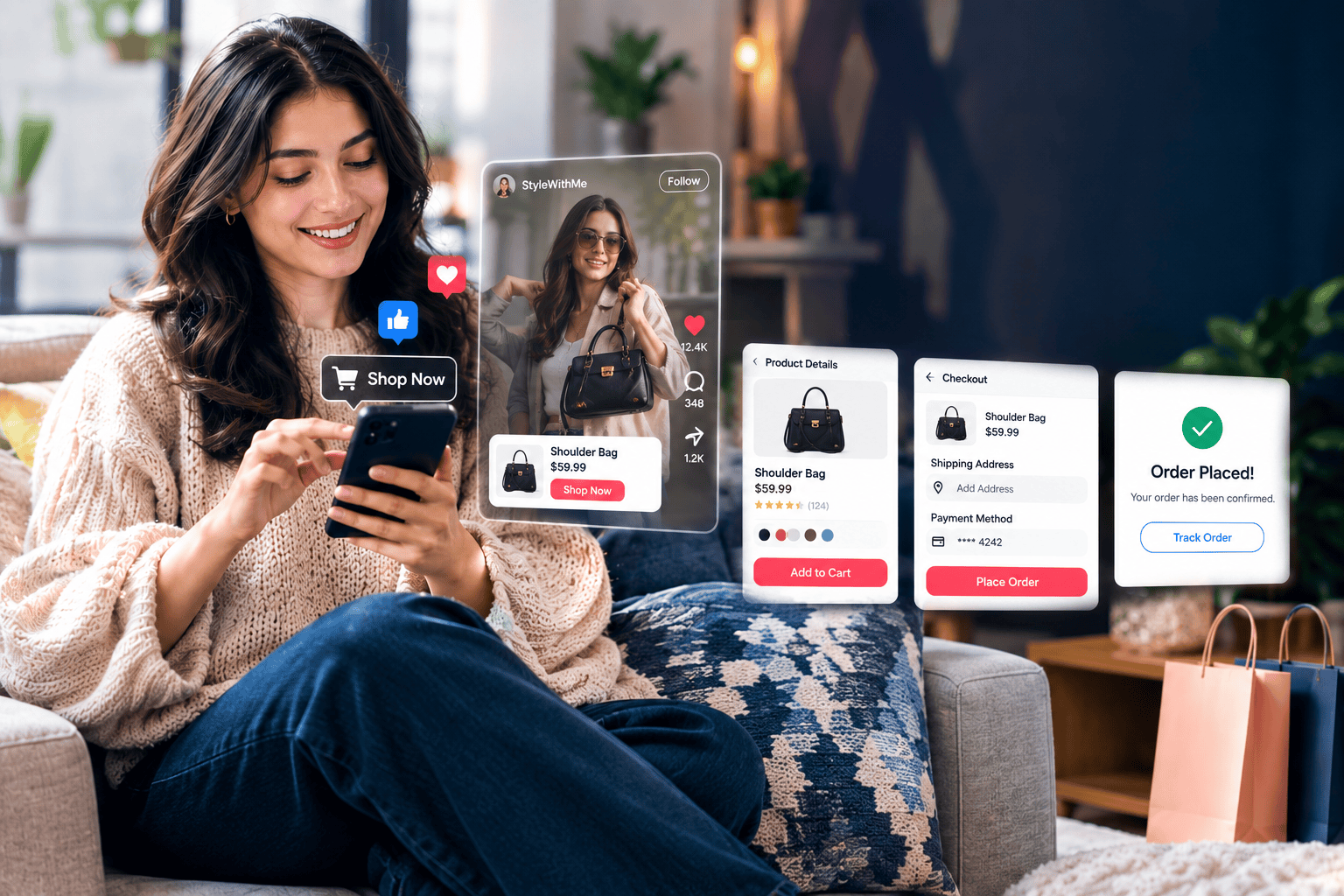
Social commerce is moving from being an extension of social media marketing to becoming a genuine commerce channel, thereby altering the way consumers discover, assess and buy products. The global market is expected to grow from about USD 156 billion in 2020 to almost USD 929 billion by 2030, highlighting how social platforms are becoming increasingly integrated into the consumer purchase process.
The growing adoption of social commerce highlights the scale of this shift, with 7 in 10 global shoppers already having purchased through social media, while 71?lieve social commerce could become their primary shopping channel by 2030. These trends suggest that social commerce is moving beyond experimentation toward mainstream consumer adoption, as platforms increasingly integrate product discovery, personalized recommendations, transactions and fulfillment into a more seamless shopping journey.
Discovery Is Becoming the New Starting Point for Purchase
A key feature of social commerce is that it can generate purchase intent rather than simply meeting pre-existing demand. In traditional e-commerce, a consumer generally starts by searching for a product or need that they already know about. Social commerce, on the other hand, reverses this process: consumers come across a product through creators, influencers, reviews or content that has been personally recommended by an algorithm and then go on to form the intention to buy.
The growing influence of social content on purchase decisions is evident, with 82% of shoppers saying that trending or viral products influence what they buy, a figure that rises to 88% among Gen Z and 91% among subscription shoppers. For brands, this means that content velocity and social relevance are increasingly capable of shaping demand, making the ability to detect, understand and respond quickly to emerging trends an important competitive advantage. This shifts competitive advantage toward brands that are able to combine content, community and commerce rather than using social media simply as a channel for raising awareness.
Consumer Segmentation Is Creating Multiple Social Commerce Journeys
The extent to which social commerce is adopted varies from one group of consumers to another, and preferred platforms show clear patterns of behavior. There is significant growth potential among Gen Z for visual and creator-led commerce, since 40% of them expect to increase their shopping on Instagram and 34% on TikTok. Their behavior shows that short-form content, trends and creator influence are becoming important means of discovering products.
Millennials have a more varied digital experience, with Instagram, Facebook and YouTube all playing important roles. This indicates that although discovery remains important, consumers in this group may also use multiple platforms to evaluate products and gather information before making a purchase. On the other hand, Gen X and Baby Boomers remain more focused on established platforms, especially Facebook and YouTube. This generational difference shows that a single social commerce strategy is unlikely to maximize reach or conversion across all consumers. Platform strategy therefore needs to be matched with the specific discovery and trust behaviours of each segment.
Instagram's Rise Signals a Shift Toward Visual Commerce
Although Facebook remains the most widely used social commerce platform, there is a growing intention among consumers to shop more on Instagram, TikTok and other visually oriented platforms.
Instagram has the greatest expected increase in shopping activity compared with the global average, with Facebook, YouTube and TikTok following. This aligns with the broader development of social commerce toward visual discovery, creator-driven recommendations and integrated product experiences. This implies that, when choosing a platform, brands should consider more than audience size. The key question is which platform most closely aligns with the consumer's decision-making process—whether the objective is trend discovery, product education, social validation or conversion.
Trust and Fulfillment Are Becoming Conversion Determinants
Social shoppers are more digitally active and, as a result, have higher expectations regarding the overall experience. The social proof needed to reduce purchase uncertainty comes from reviews, user-generated content and creator recommendations, with 62% of shoppers saying that customer reviews on social media affect their decisions.
Trust earned through content can nevertheless be severely damaged by inadequate fulfillment. The fact that 58% of shoppers expect free delivery and free returns shows that logistics and the post-purchase experience have now become essential aspects of social commerce rather than separate operational issues.
The Strategic Opportunity Is to Connect Social Signals With Commerce
The next phase of social commerce will therefore involve more than simply increasing the number of products sold through social platforms; it will be about using the consumer signals generated in social environments to influence the broader commercial strategy. Brands that are able to spot emerging trends, understand the behaviour of different customer segments across platforms, leverage social proof and connect discovery with smooth fulfillment will be better positioned to turn social engagement into measurable revenue.
China demonstrates the scale this model can reach, with 89% of shoppers making purchases via Douyin, 75% using WeChat and 66% using Little Red Book. The scale of adoption demonstrates how social media, content, community and commerce can converge within a single ecosystem.
Consult with HBGTM Insights
At HBGTM Insights, we assist companies in translating changing consumer and channel trends into practical market intelligence and growth strategies. Our research capabilities can help businesses assess social commerce adoption, consumer segmentation, platform preferences, purchase drivers, competitive positioning and emerging digital channels.
As social commerce increasingly becomes a full-funnel commercial channel rather than simply a tool for discovery, the key strategic concern for brands is to understand not only where consumers are shopping, but also what drives purchase, what establishes trust and what turns social influence into sustained growth.
Visit www.hbginsights.com to explore how research-driven insights and custom intelligence solutions can help organizations understand evolving consumers and build stronger, more relevant strategies.
Discover MoreAbout The Author

Partha Sarathi Sengupta
Partha has 20+ years of experience delivering impactful, data-driven solutions to clients across business and consumer segments. He specializes in strategic and competitive analysis, helping clients win in complex marketplaces. Before joining HBGTM Insights, Partha held leadership roles at AMI-Partners (APAC), IMaCS, Annik Technology, and has worked with ACNielsen, TNS, and Vodafone. He holds an M.Sc. in Statistics & Econometrics from the University of Calcutta and an MBA in Marketing from NPC-Delhi, and has been widely featured in leading publications like Business Standard, Economic Times, CXO, The Telegraph, CRN etc.
Know More